Budget 2021 –Analysis by Ron McKinnon, MP What is in Budget 2021 for Coquitlam Youth & Students?
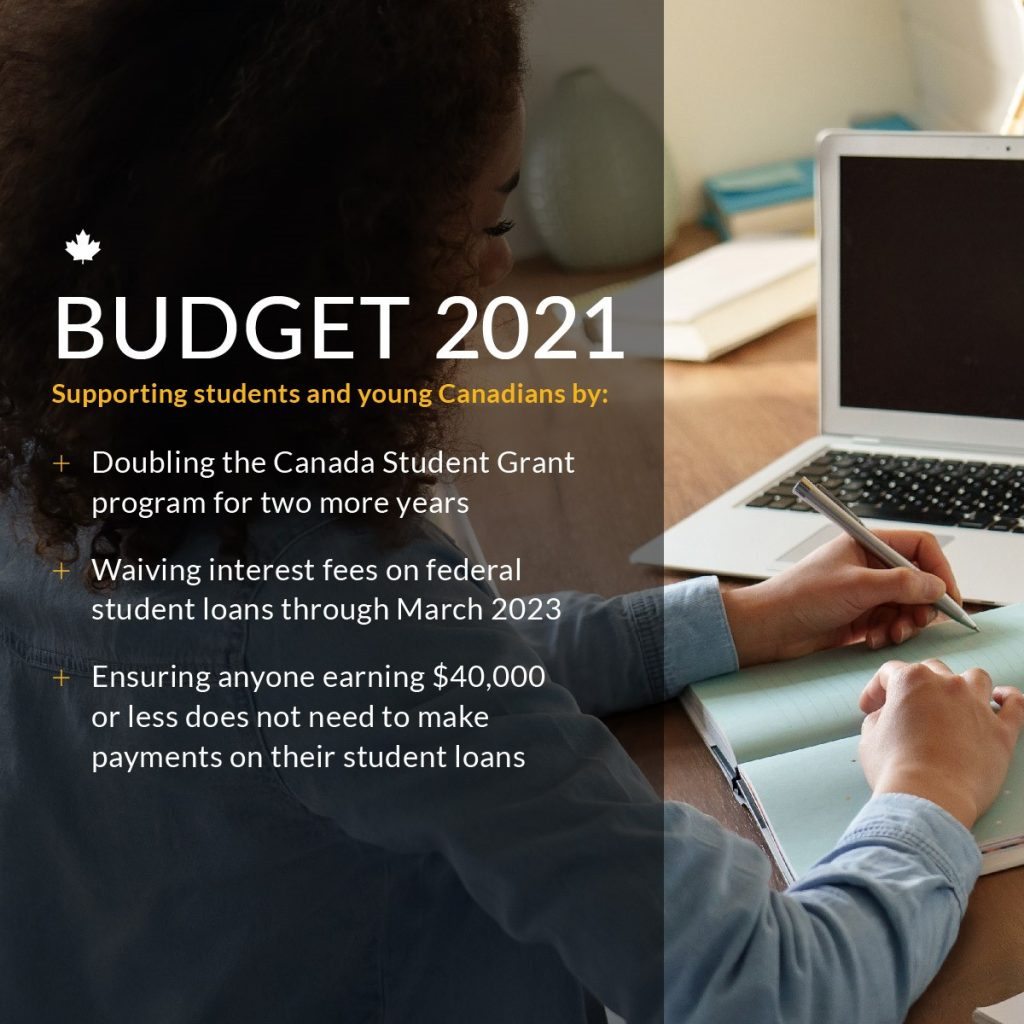
What is in Budget 2021 for Coquitlam Youth & Students?
Waiving Interest on Student Loans for an Additional Year
To ensure that the cost of post-secondary education in Canada remains predictable and affordable for everyone during the economic recovery:
- The government proposes introducing legislation that would extend the waiver of interest accrual on Canada Student Loans and Canada Apprentice Loans until March 31, 2023. This change has an estimated cost of $392.7 million in 2022-23.
Enhancing Repayment Assistance
Every year, the Government of Canada provides repayment assistance to approximately 350,000 borrowers with low incomes. Currently, the threshold for this support is earning $25,000 per year or less for a single borrower. To ensure that no federal student loan borrower ever has to make a payment they cannot afford:
- Budget 2021 proposes to increase the threshold for repayment assistance to $40,000 for borrowers living alone so that nobody earning $40,000 per year or less will need to make any payments on their student loans.
- This will support an estimated 121,000 additional Canadians with student loan debt each year.
- For students from larger households, the threshold will be modified to match the Canada Student Grants. For example, for a household with four individuals, the 2020-21 Canada Student Grant cut-off is $63,735, which rises with inflation, while the current repayment assistance threshold is $59,508.
- Additionally, the cap on monthly student loan payments will be reduced from 20 percent of household income to 10 percent.
- To ensure that the eligibility for repayment assistance keeps pace with the cost of living, the new income cut-offs will be indexed to inflation.
- Beginning in 2022-23, these changes will cost an estimated $203.5 million over four years and $64.2 million per year ongoing.
Doubling the Canada Student Grants for Two Additional Years
Over 580,000 students each year rely on federal grants and loans to help them cover the cost of their tuition, school supplies, and living expenses. When the pandemic caused other sources of income for students—such as part-time jobs— to dry up, the Government of Canada helped out by doubling Canada Student Grants for the 2020-2021 school year, providing an additional $2,600, on average, of non-repayable aid to students in need. That effectively covered 90 percent of the average undergraduate tuition in Canada for low-income students during the pandemic.
Expanding Access to Supports for Students and Borrowers with Disabilities
Students with disabilities face some of the highest costs and most significant barriers to long-term success. Every year, the Canada Student Loans Program supports over 75,000 students and borrowers with permanent disabilities through enhanced grants and repayment assistance. But these supports are not available to students whose disabilities are not lifelong.
- The government is announcing its intention to extend disability supports under the Canada Student Loans Program to recipients whose disabilities are persistent or prolonged but not necessarily permanent.
Supporting Vulnerable Children and Youth During the Recovery
COVID-19 has made life especially difficult for students at risk of dropping out of school. These students rely on local after-school programs for tutoring, counselling, and other social supports that help them stay in school, graduate on time, and access post-secondary education. As the pandemic drives education online and dries up private donations, these organizations continue to rely on their government to bridge the gap and support their vital missions.
- Budget 2021 proposes to provide $118.4 million over two years starting in 2021-22, for Employment and Social Development Canada to conduct a two-year pilot expansion of federal investments in after-school programming under the Supports for Student Learning Program. These funds would support national and local after-school organizations that work to ensure that vulnerable children and youth can graduate high school and do not become further marginalized because of the pandemic. Of this amount, $20 million will be reallocated from internal resources within the department.
Helping Youth and Students Build Job Skills and Connect with Employers
Young Canadians have seen more job losses due to COVID-19 than any other age demographic. That not only deprives them of income that could be used to pay for schooling, build their savings, or cover basic living expenses but can also lead to long-term consequences by disrupting essential experiences in the crucial early years of their working lives. These impacts are often more severe for youth facing multiple barriers to employment, such as Indigenous youth, racialized and Black youth, and newcomers to Canada.
To ensure youth and students can access valuable job skills and experience, Budget 2021 proposes investing $721 million in the next two years to help connect them with employers and provide them with quality job opportunities.
Student Work Placement Program
- Budget 2021 proposes to invest $239.8 million in the Student Work Placement Program in 2021-22 to support work-integrated learning opportunities for post-secondary students. This funding would increase the wage subsidy available for employers to 75 percent, up to $7,500 per student, while also increasing employers’ ability to access the program. That is expected to provide 50,000 young people (an increase of 20,000) with valuable experience building opportunities in 2021-22.
Supporting Access to Sexual and Reproductive Health Care Information and Services
All Canadians should have access to a full suite of sexual and reproductive health resources and services, no matter where they live. Women, youth, LGBTQ2 people, racialized Canadians, and Indigenous populations face the highest sexual and reproductive health risks and the most significant barriers to accessing support, information, and services. They often do not receive the same quality of care, mainly if they are from marginalized communities. Furthermore, examples like Clinic 554—New Brunswick’s only private abortion clinic—show us that lack of funding puts access to sexual and reproductive health care at risk. Everyone deserves equal treatment in our health care system.
To improve access to sexual and reproductive health care support, information, and services—including protecting access to abortion care:
- Budget 2021 proposes to provide $45 million over three years, starting in 2021-22, to Health Canada to fund community-based organizations that help make sexual and reproductive health care information and services more accessible for vulnerable populations. These organizations support activities such as producing inclusive training materials for sexual and reproductive health care providers, carrying out public awareness activities, and providing travel and logistical support to individuals who have to go long distances to access abortion care
Diverting Youth Away from the Justice System
At present, certain groups of young people are significantly overrepresented in the youth criminal justice system. In 2018-19, 43 percent of youth admitted to correctional services were Indigenous — over four times higher than their share
of the population.
The government is committed to addressing systemic inequities in the criminal justice system. That includes at early stages, when, instead of going into custody, young people can be redirected to community-based programming that encourages rehabilitation and reduces criminal behaviour over the long term. To address the overrepresentation of certain groups and reduce youth crime
and youth incarceration rates:
- Budget 2021 proposes to provide $216.4 million over five years, starting in 2021-22, and $43.3 million ongoing for the Youth Justice Services Funding Program to increase funding to the provinces and territories in support of diversion programming and to help reduce the overrepresentation of Indigenous peoples, Black Canadians, and other racialized groups in the youth justice system. By diverting youth to the right services at the right time and addressing the root causes of crime, this measure would help reduce the crime rate and promote better outcomes for young people and their communities.
To read the Budget 2021 speech or to review the budget documents, please visit https://www.canada.ca/en/department-finance/services/publications/federal-budget.html
 X
X