COVID-19 Update | April 18, 2020
This letter was first sent as an email to our constituents. To receive regular updates from our office regarding COVID-19, sign up via the “Get Updates” tab.
Federal Program Updates
Dear Neighbour,
This past week faith communities in our community and across Canada celebrated the holidays of Easter, Passover, and Viasakhi. Together we are learning to adapt to these challenging times by celebrating together, despite being physically distanced. I hope you are all keeping safe and taking necessary measures to implement all public health requirements by respecting physical distancing in order to protect yourself and others from COVID-19.
My staff and I have been working hard everyday to respond to the needs and concerns of our community. We are still dealing with a high volume of urgent requests, but are committed to responding to every constituent.
With things changing rapidly, I am also focused on ensuring everyone has the most up-to-date information and that it is accessible. For daily updates, follow me on Facebook, Instagram and Twitter, or visit my website.
Today’s email includes updates on:
- Canada Summer Jobs Program
- Applying for the 2nd Period of the Canada Emergency Response Benefit
- Expanding Eligibility & Access for the Canadian Emergency Response Benefit
- Canadian Emergency Wage Subsidy
- Canada Emergency Business Account
- Canada Emergency Commercial Rent Assistance
Temporary Changes to the Canada Summer Jobs Program
The Canada Summer Jobs program has been temporarily changed in order to help support young Canadians looking for employment. The changes to the program will assist small businesses to hire and keep the workers they need, in order to administer essential services.
These changes include:
- An increase to the wage subsidy. Private and public sector employers can receive up to 100% of the provincial/territorial minimum wage for each employee
- Extend the end date for the period of work under the 2020 Canada Summer Jobs to February 28, 2021
- Allow employers to adapt their projects and job activities to support essential services
- Allow employers to hire staff on a part-time basis
Applying for the Canada Emergency Response Benefit
Who can apply?
Our government announced expanded eligibility to the CERB to support workers in need of support because of COVID-19.
To be eligible, you must meet the following requirements:
- You have not applied for or received CERB or EI benefits from Service Canada for the same eligibility period
- You have not quit your job voluntarily, have lost your job for reasons related to COVID-19 and your income has been reduced to zero
- You reside in Canada
- You are 15 years old or more when you apply
- You earned a minimum of $5,000 income in the last 12 months or in 2019 from one or more of the following sources:
- employment income
- self-employment income
- provincial or federal benefits related to maternity or paternity leave
- Workers currently earning $1,000 or less a month – NEW!
- Workers expecting a seasonal job that is now no longer available – NEW!
- People who have run out of EI since January 1, 2020 – NEW!
The application portal for the Canada Emergency Response Benefit (CERB) is open!
APPLY HERE: https://www.canada.ca/en/services/benefits/ei/cerb-application.html
First time applying for CERB?
- You have stopped or will stop working due to reasons related to COVID-19
- For at least 14 days in a row, during the period you are applying for, you will not receive:
- employment income
- self-employment income
- provincial or federal benefits related to maternity or paternity leave
If you have not applied for the first period (March 15 to April 9) you are still able to apply.
2nd period of CERB applications – Important!
- You continue to not work due to reasons related to COVID-19
- For the 4 week period you are applying for, you will not receive:
- employment income;
- self-employment income; or
- provincial or federal benefits related to maternity or paternity leave.
You can now apply for the 2nd period of CERB (April 12 to May 9).
Reminder: you must reapply every 4 weeks! You can continue to apply for the CERB if you remain eligible up to a maximum of 16 weeks (4 months)
To reduce the stress on the system, due to the anticipated high volume of applicants for the Canada Emergency Response Benefit, applicants should continue to apply based on their birth month.

Please Note: this will NOT have an impact on when you receive your benefits
Please Note: If you have received two separate payments of $2000 under the Canada Emergency Response, you may have mistakenly applied twice. Don’t worry you will be contacted shortly. Only apply once for the Canada Emergency Response Benefit through either Service Canada or the CRA.
Applicants will receive their Emergency Response payments in about 3 business days after applying if they signed up for direct deposit. If you haven’t, you should get in about 10 business days
Payments will be retroactive to your eligibility date
Steps to complete before you apply to streamline your application process :
Sign up for My Account through the CRA online at: https://www.canada.ca/en/revenue-agency/services/e-services/e-services-individuals/account-individuals.html
- This will speed up your application process once the portal launches
Sign up for Direct Deposit
- This will help money get to your account faster once your application is processed
Please Note: if you already have a BC Services Card you can log into the Canada Revenue Agency’s My Account with that credential and sign up for direct deposit.
Canada Emergency Wage Subsidy

What is the Canada Emergency Wage Subsidy?
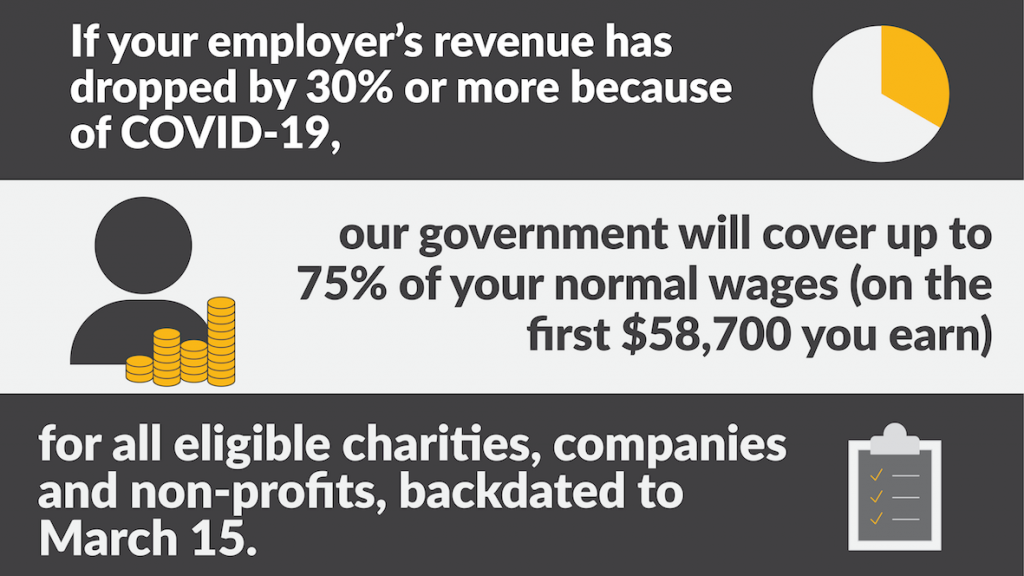
- The Wage Subsidy will cover 75 percent of an employee’s wages for businesses of all sizes across all sectors for up to 12 weeks, retroactive to March 15, 2020
- This includes individuals, taxable corporations, not-for-profit and charities, partnerships consisting of eligible employers and aims to prevent further job losses, encourage employers to re-hire workers laid off as a result of COVID-19.
- Employers of all sizes from all sectors can apply, provided they have seen a minimum 15% reduction in gross revenue for March 2020 and 30% for subsequent months
- When applying for the wage subsidy, employers are required to confirm the decline in revenue
Calculating Revenues
- An employer’s revenue would include its revenue in Canada earned from arm’s-length sources
- Revenue will be calculated using the employer’s normal accounting method and would exclude revenue from extraordinary items and amounts on account of capital
- Employers can calculate their revenue under the accrual method or the cash method, but not a combination of both. Employers will select an accounting method when first applying for the wage subsidy and are required to use that method for the entirety of the program
Calculating revenue for registered and non-profit organizations
- Calculation will include most forms of revenue (excluding revenue from non-arm’s length persons)
- Organizations have the ability to choose whether or not to include revenue from government sources as part of the calculation. Once chosen, this choice will apply throughout the program period
Amount of Subsidy
The subsidy amount for a given employee on eligible remuneration paid between March 15 and June 6, 2020 would be the greater of:
- 75% of the amount of remuneration paid, up to a maximum benefit of $847 per week
- The amount of remuneration paid, up to a maximum benefit of $847 per week or 75% of the employee’s pre-crisis weekly remuneration, whichever is less
Employers may be eligible for a subsidy of up to 100% of the first 75% of pre-crisis wages or salaries of existing employees
- Employers in this case, would be expected when possible to maintain existing employee’ pre-crisis employment earnings
The pre-crisis remuneration for a given employee is based on the average weekly remuneration paid between January 1 and March 15 inclusively, excluding any seven-day period in which the employee did not receive any remuneration
Employers will also be eligible for a subsidy of up to 75% of salaries and wages paid to new employees, including salary, wages, and other remuneration like taxable benefits.
- Employers would usually be required to withhold or deduct amounts to remit to the Receiver General on account of the employee’s income tax obligation. This does not include severance pay, or stock option benefits, or the personal use of a corporate vehicle
There would be no overall limit on the subsidy amount that eligible employers may claim.
Employers are expected to make their best effort to top-up employees’ salaries to pre-crisis levels, if possible
Eligible Periods
Employers are able to calculate the change in their revenue with an alternative benchmark in order to establish their eligibility. This provides flexibility for employers for which the typical approach is not applicable as well as employers established after February 2019.
- Under the alternative approach, employers are able to compare their revenue using an average of their revenue from January and February 2020
- Employers will either choose the general year-over-year approach or the alternative approach in their first application to the wage subsidy and will be required to use their chosen approach for the duration of the program
- In order to provide certainty to employers, if you are found eligible for a specific period, you will automatically qualify for the next period

Eligible Employees
- Individuals who are employed in Canada
- Eligibility for the wage subsidy of an employee’s remuneration will be available to employees other than those who have been without remuneration for 14 or more consecutive days in the eligibility period
Please Note: this replace the previously announced restriction that an employer would not be eligible to claim the wage subsidy for remuneration paid to an employee in a week that falls within a 4-week period for which the employee is eligible for the Canada Emergency Response Benefit
How to Apply
- Eligible employers will be able to apply for the wage subsidy through the Canada Revenue Agency’s “My Business Account Portal” in addition to a web-based application
- Employers will need to provide records demonstrating the reduction in their arm’s-length revenues as well as the remuneration paid to employees
I will provide more information about the application process as it becomes available in the coming days.
Canada Emergency Business Account (CEBA)
To ensure small business are able to access the capital the need during these challenging time, our government launched the Canada Emergency Business Account which has been implemented by eligible financial institutions in cooperation with Export Development Canada (EDC)
- CEBA will provide interest-free loans of up to $40,000 to small businesses and not-for-profits, to help cover their operating costs while their revenues have been temporarily reduced
- In order to be eligible, organizations will need to show that they paid between $20,000 t0 $1.5 million in total payroll in 2019
- Business owners are able to apply for CEBA through their banks and credit unions
- If the balance of the loan is repaid on or before December 31, 2022, business will receive loan forgiveness of 25 percent (up to $10,000)
What are the eligibility requirements for the CEBA?
- The Borrower is a Canadian operating business in operation as of March 1, 2020
- The Borrower has a federal tax registration
- The Borrower’s total employment income paid in 2019 was between Cdn. $20,000 and Cdn. $1,500,000
- The Borrower has an active business chequing/operating account with the Lender, which is its primary financial institution. This account was opened on or prior to March 1, 2020 and was not in arrears on existing borrowing facilities, if applicable, with the Lender by 90 days or more as at March 1, 2020
- The Borrower has not previously used the Program and will not apply for support under the Program ay any other finance institution
- The Borrower acknowledges its intention to continue to operate its business or to resume operations
- The Borrower agrees to participate in post-funding surveys conducted by the Government of Canada or any of its agents
Canada Emergency Commercial Rent Assistance (CERCA)
Our government announced the introduction of the Canada Emergency Commercial Rent Assistance (CERCA) program for small businesses that will seek to provide loans and/or forgivable loans to commercial property owners who in turn will lower or forgo the rent of small businesses for the months of April (retroactive), May, and June.
In order to implement this program, our government will need to partner with provincial and territorial governments who are responsible for property owner-tenant relationships.
More details on this program will be available soon!
Yours sincerely,

Ron McKinnon
Member of Parliament for Coquitlam – Port Coquitlam
 X
X